
How to Check Criminal History in Moore Haven
Moore Haven has no single city criminal-history screen. SmartWEB answers recent booking questions. The Glades Clerk answers what prosecutors filed and how each charge ended. GCSO or another arresting agency holds the incident narrative. FDLE compiles reportable Florida arrests and dispositions. Using them in order keeps a preliminary allegation from being mistaken for a final result.
- Search GCSO SmartWEB and record booking and court case numbers.
- Ask the identified arresting agency for the incident report and releasable supplements.
- Use the Glades Clerk route for filed charges and dispositions.
- Request a clerk search, copy, or certification if the online result is incomplete.
- Use FDLE CCH for statewide history or Personal Review for your own accuracy check.
Moore Haven's County Records Role
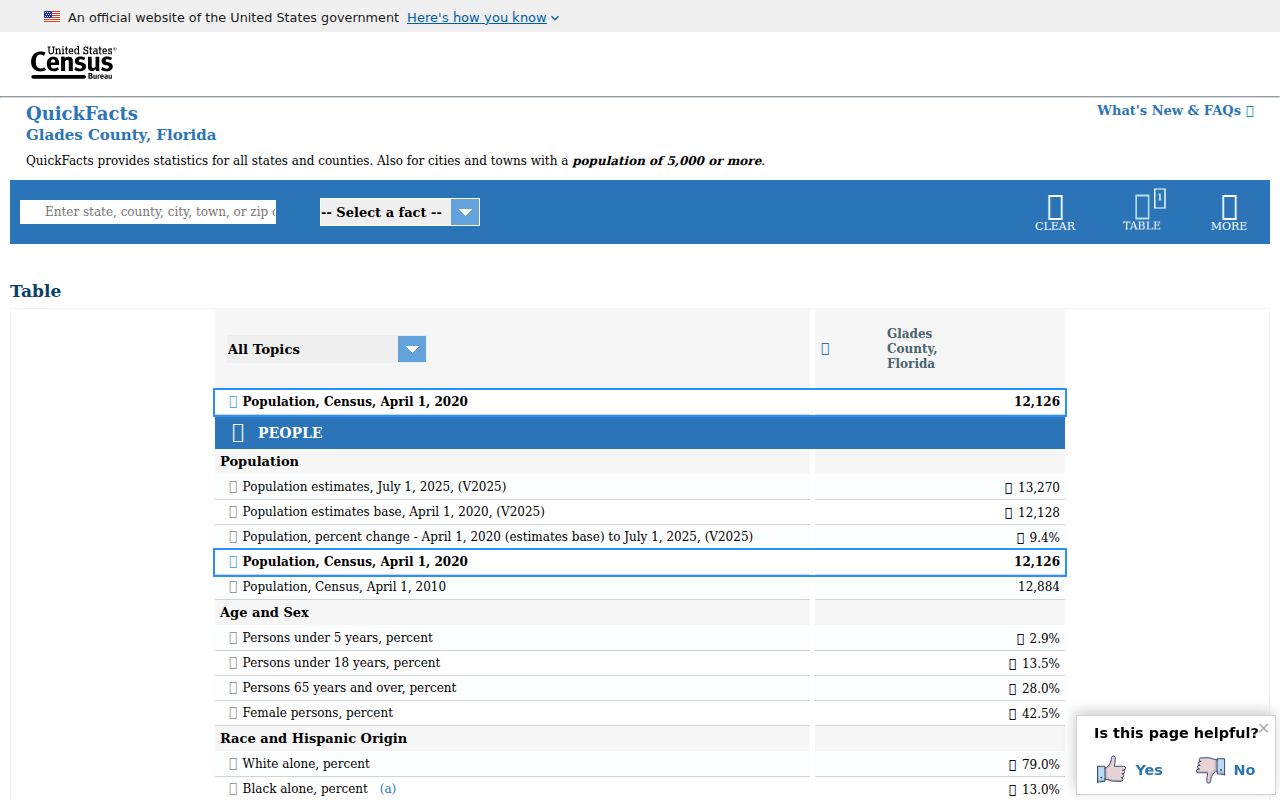
Moore Haven is the Glades County seat and its only incorporated city. The official 2020 Census counted 1,566 city residents and 12,126 county residents. Glades County covers 806.82 land square miles. That context explains why records tied to a Moore Haven address live mainly in county and state systems.
The Census county profile pictured here supplies the population and land figures.
Buckhead Ridge, Palmdale, Lakeport, and Muse are not separate incorporated cities with municipal criminal archives.
The distinction matters when a search starts with a mailing address or a place name. An incident near Moore Haven may fall within GCSO jurisdiction without producing any city-held record. The county seat is where the clerk keeps criminal court files, yet that does not turn every county event into a Moore Haven crime statistic. No verified current municipal UCR table was captured, so county incidents should not be presented as city incidents.
The Moore Haven Police Department
No independent Moore Haven Police Department records page or verified city police archive was found in official sources. Most local law-enforcement questions route to GCSO unless the event names another agency. The proper answer is the real custodian, not an invented city police counter, form, phone number, or app.
For a GCSO event, ask the sheriff's official channel for the records custodian. Describe the record, date, location, case number, and desired format. Ask for an electronic copy and estimate. Chapter 119 covers existing records; it does not compel an agency to write an explanation. Active-investigation, juvenile, victim, and security-sensitive facts may be redacted or withheld.
Moore Haven Arrest Agency Routes
A Moore Haven location does not prove GCSO made the arrest. Florida Highway Patrol keeps its investigative records. Florida Fish and Wildlife Conservation Commission keeps conservation cases. FDLE, tribal, and federal agencies keep records they create. SmartWEB may show a county booking after another agency delivers a person to jail, but the narrative remains with that agency.
Read the arresting-agency field before requesting records. Ask for the incident report and releasable supplements by case number and date. Then use the court number in SmartWEB to reach the Glades Clerk. This captures both the event report and prosecution file.
Arrests and Bookings in Moore Haven
No city jail was verified. County bookings appear in SmartWEB, which supports name, booking-date, and release-date searches plus Booked Last 24 Hours. A row can show status, booking and MNI numbers, time, age, bond, arresting agency, statute, charge, degree, arrest number, and court case number. It is a recent-custody tool.
It is not a conviction database. Booking charges can change after prosecutor review. Bond fields can change after first appearance. Capture the court case number, then check the clerk for filed counts and outcomes. For an old booking absent online, request the booking sheet from GCSO.
Moore Haven SmartWEB Date Searches
SmartWEB requires at least one criterion. First, middle, and last name can narrow a query. Date ranges cover booking and release. Search, sort, and order controls also appear, though not every live dropdown option was verified. Do not rely on a control that is absent from the current screen.
Booking number identifies the custody event. MNI is the sheriff system's master-name identifier. Arrest number points to an arrest entry. The court number bridges to the clerk. None should be called an FDLE SID unless a state record uses that label.
Charge rows deserve a second look. A sheriff-style charge identifier may appear beside a later court-numbered row. That can reflect the record's move from arrest to prosecution, not two findings of guilt. Statute, degree, level, and bond describe the data shown at that time. The clerk docket and State Attorney filing resolve which accusations reached court. Before travel or payment, confirm bond with the jail or court because a later judicial order may control.
Moore Haven Municipal Court Records
No separate Moore Haven municipal criminal court or case portal was verified. Florida County Court handles misdemeanors and criminal traffic, while Circuit Court handles felonies. Both record sets are kept by the Glades Clerk at 500 Avenue J, Moore Haven, FL 33471. Fine-only local ordinance matters, if prosecuted, should be confirmed with the city and clerk rather than sent to a fictional municipal docket.
| Court Name | Glades County Court or Twentieth Judicial Circuit |
|---|---|
| Case Types Heard | County Court: misdemeanors and criminal traffic; Circuit Court: felonies |
| Case Lookup Channel | Clerk court-record link, clerk counter, or specific written request |
| What the Docket Shows | Filed counts, events, pleas, judgment, sentence, and charge dispositions |
| Copies & Fees | $2 name/case search, $1 per page, and $2 certification |
Moore Haven Clerk Copy Route
The clerk's main telephone is (863) 946-6010. Criminal traffic uses (863) 946-6012. Search online first, then ask for a specific file if a public document does not display. A blank online result means “not located,” not proof that no record exists. Confidential cases, protected images, sealed records, and court orders can limit online access.
Mail requests require advance confirmation of the page count, a check payable to Glades Clerk of Court, and a self-addressed stamped envelope. Do not mail cash. The clerk states seven to ten working days for mail. An inactive off-site file may require another day or more, so call before a time-sensitive visit or order.
Certification answers an authenticity question. It verifies the clerk's copy from that case. It does not broaden the search to another Florida county, supply a police narrative, or convert the file into an FDLE report. Order the docket or disposition that fits the need, and ask for certification only when official proof of the clerk record is required. Searching name variations, suffixes, and an approximate filing year can help the clerk identify a difficult case.
| Service | Fee |
|---|---|
| Name or case search | $2 |
| Copy | $1 per page |
| Certification | $2 additional |
Where Moore Haven Records End Up
An arresting agency creates the incident and arrest report. The county jail creates the booking entry. The State Attorney decides what to file, and the Glades Clerk opens the County or Circuit Court case. Fingerprint-linked arrest and disposition data should then reach FDLE's statewide repository.
Record flow: Arresting agency › GCSO booking › Glades County Courts › Florida Department of Law Enforcement
Recent activity may appear in SmartWEB before prosecution is filed. The clerk record controls the local court outcome. FDLE provides a broader Florida compilation, but a missing disposition may require comparison with a certified clerk copy and free FDLE Personal Review.
Moore Haven Booking to Disposition
A charge row can carry an agency identifier and later gain a court case number. That does not prove two convictions or two filed counts. The State Attorney's information states what is prosecuted. Read the court disposition charge by charge: dismissal or nolle prosequi is not a conviction, acquittal follows a not-guilty result, withhold is not dismissal, and adjudication guilty is a conviction.
The practical chain is short: save the SmartWEB booking number, locate the court number, search the clerk docket, and order the disposition when authentic proof is needed. A certified local disposition proves that clerk record. It does not become a statewide criminal-history report.
If the FDLE record lacks that disposition, a person reviewing their own history can request free fingerprint-based Personal Review. Compare it with the certified Glades disposition and ask the responsible source to correct a mismatch. The public FDLE name search is broader than one county, but it is not fingerprint identification. That makes the subject-only Personal Review the stronger route for an accuracy challenge involving identity or an unfinished arrest cycle.
Moore Haven Clerk Contact Fields
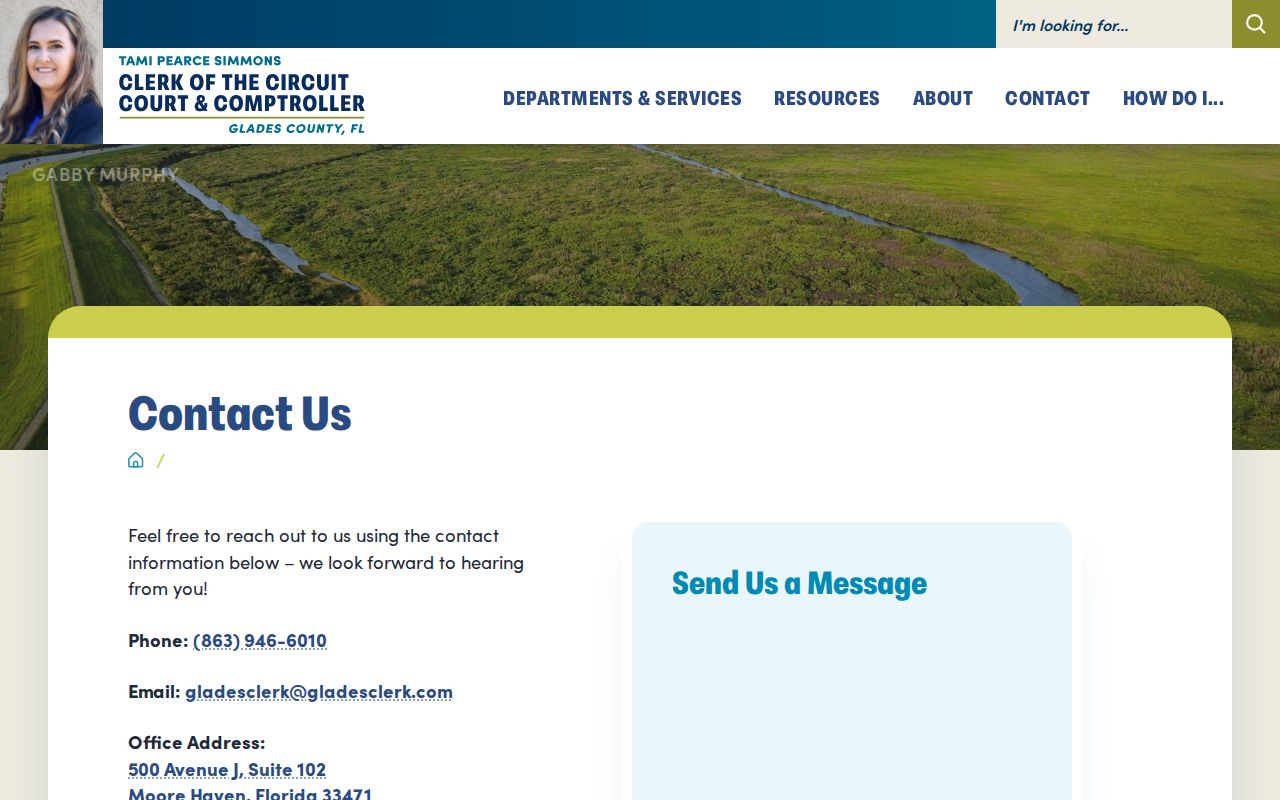
The clerk's web contact form is a preliminary contact route, not a substitute for a precise records request. It requires name, phone, and email. Optional fields include referral source, address, city, state, ZIP, and comments, plus an anti-spam field.
The official contact form pictured here identifies the clerk's web channel and records-custodian details.
For a file request, put the case number, full name variations, approximate year, and desired document in the comments, then follow clerk instructions for fees and delivery.
A request should seek records rather than answers. “Incident report and releasable supplements for agency case number X on date Y” tells the custodian what to locate. “Why was this person arrested?” asks the office to create an explanation that Chapter 119 does not require. Specific language also helps the custodian estimate redaction work and copy cost before performing chargeable work.
Public Access Rules
Florida law starts with access but preserves specific exemptions. GCSO holds its reports and booking files; the clerk holds filed cases; FDLE holds the statewide compilation. A requester normally need not state a purpose. Agencies may redact juvenile, victim, active-investigation, sealed, and personal-identifying information. Judicial records follow Rule 2.420, so a written request must identify the court record with enough detail.
Key Statutes:
Florida Public Records Law, Chapter 119 requires access to nonexempt state and local records and permits lawful copy and extensive-use charges.
Florida Statutes §§943.053 and 943.056 govern public criminal-history access and a person's review of their own state record.
Florida Rule 2.420 governs public access and confidentiality for judicial branch records.